
Reviewed · KIBERA COMMUNITY TOURS
Kibera Slum Tour with a Local
Kibera rewards a respectful approach. This three-hour walk with OAC Kenya Tours is led by guides who were born, raised, and still live in Kibera, giving you direct insight into daily life rather than a distant view from a vehicle. I like the local leadership and the clear social purpose: 50 percent of the booking fee helps pay school fees for children in the community. I also like the planned home visit and craft stop, which show work, family life, and local enterprise instead of reducing Kibera to poverty alone. The main consideration is that this is an intimate community visit, so you must be comfortable seeing difficult living conditions and follow your guide’s lead around homes and children.
The tour costs $25 per person and lasts about three hours. It begins and ends at Prestige Plaza Shopping Mall on Ngong Road, with bottled water or soda included. The office has Wi-Fi, clean washrooms, and a secure guest room, though the central value is the chance to learn from people who know Kibera as home.
In This Review
- Key points to know before you book
- Why this Kibera visit feels different
- Starting at the OAC Kenya Tours office
- Seeing recycling become useful craft
- Meeting children with care and respect
- Entering a local home
- Taking a break at the cafeteria
- The social impact behind the $25 price
- Safety, comfort, and group size
- Who will appreciate this tour most
- Booking details and cancellation
- Should you book the Kibera Slum Tour?
- FAQ
- Where does the Kibera tour start?
- Where does the tour end?
- How long does the tour last?
- How much does the tour cost?
- What is included in the price?
- How many people can join the tour?
- Can the tour be customized?
- What happens if I need to cancel?
Key points to know before you book

- 50 percent supports school fees: Half of the booking fee goes toward helping needy children in the Kibera community.
- Four local guides lead the operation: OAC Kenya Tours is run by guides who were born and raised in Kibera and still live there.
- Five stops give the visit structure: You visit the office, a crafts center, a children’s meeting, a local home, and a cafeteria.
- The home visit makes this personal: You are invited inside one local house, an experience that calls for courtesy and sensitivity.
- Small details improve the morning: Bottled water or soda is provided, and the office has clean washrooms and free Wi-Fi.
- The tour can be adjusted: The team says it can customize the experience around your interests.
Why this Kibera visit feels different

Many city tours explain a community from the outside. Here, the guides are part of the place they introduce. OAC Kenya Tours has four local guides, including Erick and Sammy, who are praised for speaking openly about the realities of life in Kibera and for answering questions with care.
That local connection matters. The guides know the streets, the people, and the challenges because they live there. You are not simply being shown a poor neighborhood as a spectacle. You are being introduced to a community through a social enterprise that sends part of its income back into local education.
The tour also works with KCOOP Organization, a nonprofit officially established and registered in 2022. KCOOP operates in Kibera and rural parts of Kenya. The broader aim is to support children who need help with school fees and to seek partnerships that can extend this work.
Still, the social purpose does not remove the need for good manners. A visit to Kibera can be meaningful, but it should never become a photo hunt. Ask before photographing people, especially children, and let the guide explain what is appropriate. The strongest part of the experience is listening, not collecting dramatic images.
More Kibera community tours:
- Nairobi: Explore Kibera Slum with Local Guides
★ 4.9 · 365 reviews - Kevins Kibera Slum Tours
★ 5.0 · 213 reviews - Nairobi: Kibera Slum storytelling tour with a Local
★ 5.0 · 185 reviews
Starting at the OAC Kenya Tours office
Your meeting point is Prestige Plaza Shopping Mall, on Ngong Road in Nairobi. From there, the tour returns to the same meeting point at the end, which makes the three-hour plan easier to fit around other Nairobi activities.
The first stop is the OAC Kenya Tours office in Kibera. This is where introductions take place and the guides explain how the visit will work. That opening briefing is useful because it gives you a chance to ask questions before entering the community.
The office also has free Wi-Fi and clean washrooms. Those may sound like minor details, but they are handy at the start of a walking tour. Bottled water or soda is provided as part of the price.
OAC also has a secure guest room for people interested in spending a night in Kibera at an additional cost. The information provided does not give the overnight price or a separate schedule, so treat that as an extra option to arrange directly rather than part of the $25 tour.
Seeing recycling become useful craft

At the crafts center, you see local people reuse materials to make jewelry and other handmade goods. This stop adds an important angle to the visit: Kibera is not only a place of need, but also a place where people make, sell, and create income.
The crafts center is likely to appeal to anyone interested in social enterprise or practical environmental work. OAC Kenya Tours is connected with OAC Kenya Crafts, another of the group’s social enterprises. If products are available for sale, buying directly can be a more personal way to support local work, though the supplied details do not confirm what items or prices are offered on a particular day.
This is also a good point to ask how materials are collected and how the craft income is used. The guides say the tour can be customized, so a deeper discussion of local business or recycling may be possible if you request it in advance.
Meeting children with care and respect

The third stop involves meeting children in the community. It can be one of the most affecting parts of the visit, especially because the social program helps pay school fees for children who need support.
The children are described as friendly with the guides, and some may follow the group around. That detail shows the value of local relationships. The guides are known in the area, which can make the encounter feel more natural and less intrusive than a visit led by outsiders.
You should approach this part with care. Do not assume that children want to be photographed or given gifts. One person who joined the tour brought lollipops and found the children happy to receive them, but that should not be treated as a requirement. Ask your guide what is suitable before bringing anything, and remember that the most useful support is the ongoing school-fee work funded through the tour.
This stop may feel emotionally heavy. The point is not to compare your life with someone else’s or to search for a lesson in hardship. Listen to the explanation of the challenges facing families, then ask about the ways residents support one another and work toward better opportunities.
A few more options to weigh up in Nairobi
- Nairobi National Park Half-Day Tour; Free Wi-Fi connection
★ 5.0 · 878 reviews - Nairobi: National Park & Optional Elephants & Giraffe Center
★ 4.8 · 874 reviews - NAI NAMI: Nairobi Storytelling Tour with Street Children
★ 5.0 · 792 reviews - Nairobi National Park Half-Day Game Drive
★ 4.5 · 738 reviews
Entering a local home

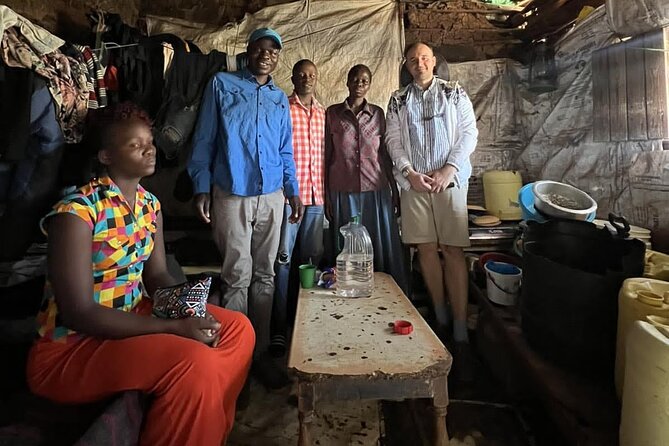
The home visit is the most personal stop on the route. You are welcomed into one of the local houses, giving you a closer look at domestic life in Kibera than a walk past buildings can provide.
Because this involves a real family home, courtesy matters more here than anywhere else. Follow the guide’s instructions, keep your visit respectful, and ask before taking pictures. You may want to ask how the family chose to participate and how home visits are arranged, especially if you are concerned about privacy.
The supplied information does not describe the home’s size, furnishings, or family circumstances, so no honest review should invent those details. What you can expect is a direct invitation into a local household and the chance to hear more about ordinary life from the people who live there.
Some visitors find this stop humbling. That reaction is understandable, but try not to let pity become the whole story. A home is more than its material conditions. Give attention to the family’s dignity, daily routines, and personal choices.
Taking a break at the cafeteria

The final listed stop is a cafeteria, where you take a short rest and can have soft drinks or local food while the guides explain more about Kibera. A pause is welcome after several stops, and a meal or drink gives the conversation a relaxed setting.
The information does not specify which dishes are served or whether food is included in the $25 price. Bottled water or soda is included, but you should ask about the cost of any local food before ordering.
This stop is also a useful time for questions. You can ask about income, schooling, housing, community projects, and the work of KCOOP Organization. If you want the tour to focus on one subject, tell the team when you book or during the opening briefing.
The social impact behind the $25 price

At $25 per person, this is not just a paid walk through Nairobi. Half of the booking fee goes toward school fees for needy children in Kibera. That gives the price a clear purpose and makes it easier to judge the tour on both experience and local benefit.
The value is strongest if you want a guided introduction led by people from the community and you care where your money goes. You receive about three hours of guiding, five planned stops, bottled water or soda, all fees and taxes, and access to the office facilities.
The price does not include every possible expense. Food at the cafeteria is not clearly listed as included, and an overnight stay costs extra. You should also remember that the tour’s social impact depends on the organization’s stated use of its income, so anyone seeking detailed financial reports should check the KCOOP website or social media before booking.
The team also runs OAC Kenya Crafts and KCOOP Organization. That wider structure suggests the tour is part of an ongoing effort rather than a one-time collection of donations. Still, you should choose the experience for the community conversation and guided access first, with the social contribution as an important added benefit.
Safety, comfort, and group size

The guides are described as professional and experienced, and the tour is designed for a maximum of 30 people. That limit is helpful, though a group of 30 can still feel fairly large during a home visit or a conversation with children.
The office is described as safe and secure, with clean washrooms. The guides are local and known in the area, which helps create a sense of reassurance. One participant specifically felt safe during the visit.
The tour is near public transportation, begins and ends at the same meeting point, and allows service animals. Most people can participate, according to the provided information. The experience requires good weather, so poor conditions may lead to a new date or a full refund.
The listing does not state the exact walking distance, road conditions, or whether the route is suitable for wheelchairs. If you have mobility concerns, ask OAC Kenya Tours before booking. That is also wise if you need a particular pace or want to avoid stairs and uneven paths.
Who will appreciate this tour most
I would recommend this experience to you if you want direct local contact, are ready to listen, and can approach Kibera without treating it as a curiosity. It suits visitors who value community-led tourism and want part of their payment to support school fees.
It is also a good fit if you want more than a standard sightseeing morning in Nairobi. The crafts center, home visit, cafeteria, and conversations with guides create a wider picture of life than a simple street walk.
You may want to choose another activity if you dislike emotionally difficult subjects, feel uneasy entering private homes, or expect a polished attraction with a fixed script. This is a community visit, not a museum. The conditions may be confronting, and the experience depends heavily on respectful interaction.
Families should use their judgment around the children’s meeting. The information says most people can participate, but it does not provide a specific minimum age or child policy. Ask the provider before booking for young children.
Booking details and cancellation
The tour is available with a mobile ticket, and confirmation is received at booking. It is booked about 12 days in advance on average, so you should not leave it until the last minute if the date matters to you.
You can cancel for a full refund up to 24 hours before the start time. Cancellations or changes made within 24 hours are not refunded or accepted. If bad weather forces the operator to cancel, you are offered another date or a full refund.
Because the meeting point is Prestige Plaza Shopping Mall and the tour ends there, allow enough time to reach Ngong Road before the start. The exact start time is not provided here, so confirm it when you reserve.
Should you book the Kibera Slum Tour?
Book it if you want a locally led, socially focused visit and are willing to meet Kibera with humility. The strongest reasons are the guides’ personal connection to the community, the five varied stops, and the commitment to direct 50 percent of booking fees toward school fees.
I would not book it simply to take striking photographs or collect a dramatic story. The home visit and children’s meeting require respect, patience, and good judgment. If that approach suits you, $25 is a fair price for three hours of guided contact and a clear community contribution.
FAQ
Where does the Kibera tour start?
The tour starts at Prestige Plaza Shopping Mall on Ngong Road, Nairobi, Kenya.
Where does the tour end?
The activity ends back at the meeting point at Prestige Plaza Shopping Mall.
How long does the tour last?
The tour lasts approximately three hours.
How much does the tour cost?
The price is $25 per person.
What is included in the price?
Bottled water or soda, along with all fees and taxes, is included.
How many people can join the tour?
The maximum group size is 30 people.
Can the tour be customized?
Yes. OAC Kenya Tours says the experience can be adjusted to match your interests.
What happens if I need to cancel?
You can receive a full refund if you cancel at least 24 hours before the start time. Cancellations or changes made less than 24 hours before the start time are not accepted and are not refunded.
Just added in Nairobi
- Wildlife Capital: Half-Day Safari at Nairobi National Park★ 5.0 · 2 reviews
- 3 days maasai mara migration safari★ 4.5 · 7 reviews
- 4 Days Tour Landcruiser in Masai Mara and Lake Nakuru★ 5.0 · 10 reviews
- 4 Days Safari to Lake Nakuru N/P and Maasai Mara N/R★ 5.0 · 18 reviews
- Day Tour to Nairobi national park, Elephants, and Giraffe Center★ 3.5 · 8 reviews
- 6 Days Kenya Budget Group Safari★ 5.0 · 2 reviews
- Maasai Mara Day Trip★ 5.0 · 15 reviews
- 3 Days Masai Mara Wildebeest migration Budget safari★ 5.0 · 2 reviews
Kibera Community Tours, compared.





Kibera Slum Tour with Local Social Entrepreneurs
Read our review →


Browse the lists this tour appears in