

Reviewed · KIBERA COMMUNITY TOURS
Kevins Kibera Slum Tours
Kibera is more than a stop on a map. Kevin’s Kibera Slum Tours gives you a close look at daily life in Nairobi’s largest informal settlement, led by someone who grew up there. I like the local guide and the chance to visit a family home, school, market, and crafts workshop. The private format also keeps the experience personal.
You pay $65 per person for about four hours, including hotel pickup and drop-off in Nairobi. That feels fair if you value direct community contact rather than a polished sightseeing show. The main drawback is the walk: uneven, muddy paths can be difficult, especially after rain or for anyone with balance or mobility problems.
In This Review
- Key points to know before you book
- Why this Kibera tour feels different
- Starting at 8:00 am with hotel pickup
- Walking through Kibera with Kevin or Ismael
- The bone workshop and local enterprise
- The school, orphanage, and education efforts
- Kevin’s home and a family welcome
- The market, landfill, and railway track
- What the $65 price really covers
- Clothing, comfort, and safety
- How to get the most from the visit
- Who should book Kevin’s Kibera Slum Tours?
- FAQ
- Where does Kevin’s Kibera Slum Tour take place?
- How long does the tour last?
- What time does the tour start?
- Is hotel pickup available?
- Is the tour private?
- What is included in the price?
- Are food and drinks included?
- What places can I visit during the tour?
- Is the tour suitable for people with walking difficulties?
- What is the cancellation policy?
Key points to know before you book

- Kevin and Ismael lead from personal experience: Both are closely connected to Kibera, and Ismael is Kevin’s brother.
- The route includes real community spaces: Expect a school or orphanage, a bone crafts workshop, a market, a landfill area, a train track, and family homes.
- You get a private tour: Only your own group takes part, which gives you more room for questions and conversation.
- Hotel pickup starts at 8:00 am: Front-door transport is offered from hotel accommodation anywhere in Nairobi.
- Wear shoes you can sacrifice: Close-toed shoes are a smart choice, and they may become very dirty.
- The experience is serious but not joyless: You see hardship, but also family life, local enterprise, education efforts, and strong community ties.
Why this Kibera tour feels different

A visit to Kibera can easily become a quick photo stop, with outsiders looking in and then leaving. Kevin’s Kibera Slum Tours takes a better route. The guide is not simply repeating facts about poverty. He explains the place through his own life, family, neighbors, and community connections.
That matters. You can ask what you see instead of guessing. A narrow path, a schoolroom, a workshop, or a crowded market means more when a local person explains how people use it and what problems they face.
Kevin and Ismael receive the strongest praise for their warmth and hospitality. Ismael, in particular, is described as a thoughtful host who welcomes people into his home and introduces them to family members. The tone is personal, not staged for a busload of strangers.
You should still approach this visit with care. Kibera is home, not a human exhibit. Ask before taking photographs, listen more than you speak, and avoid treating hardship as entertainment. The tour works best when you arrive ready to meet people, not just collect dramatic images.
More Kibera community tours:
- Nairobi: Explore Kibera Slum with Local Guides
★ 4.9 · 365 reviews - Nairobi: Kibera Slum storytelling tour with a Local
★ 5.0 · 185 reviews - Kibera Slum Tour with Lucas
★ 5.0 · 119 reviews
Starting at 8:00 am with hotel pickup
The morning start is useful in Nairobi. You are collected from your hotel at 8:00 am, then driven to Kibera for the walking portion. Round-trip pickup and drop-off are included for hotel accommodation in the city, so you do not need to arrange a separate taxi or find the starting point yourself.
Allow extra flexibility around the pickup time. One person reported waiting about an hour beyond the expected collection time. That may not happen to you, but Nairobi traffic and local timing can change plans. Keep the morning free, confirm the pickup details when you book, and do not schedule an airport transfer immediately afterward.
The advertised experience lasts about four hours, with roughly three hours at the Kibera stop. That leaves time for transport and the transition into the walking route. Since the activity is private, the pace can suit your group better than a large scheduled outing, though the terrain itself sets the limits.
Walking through Kibera with Kevin or Ismael

The most important part of the experience is the guide. Kevin is a lifelong Kibera resident, and Ismael, his brother, also leads tours. Their local relationships help explain why the walk can feel welcoming rather than intrusive.
You may pass through busy residential paths, commercial areas, and main streets. The route is not designed as a neat circuit with signs and barriers. It is a working neighborhood, and you may need to step carefully around uneven ground, open spaces, mud, rubbish, and other obstacles.
That physical setting is one reason this tour can be powerful. You are not viewing Kibera from a vehicle window. You are walking through places where people live, work, study, shop, and raise children.
It is also the reason I would not recommend this experience to everyone. A report from a woman traveling alone described feeling safe with Ismael, and the guides are widely regarded as respected members of the community. Still, comfort and safety are personal matters. You should be alert, follow the guide, keep valuables secure, and decide honestly if you can manage a rough three-hour walk.
The bone workshop and local enterprise

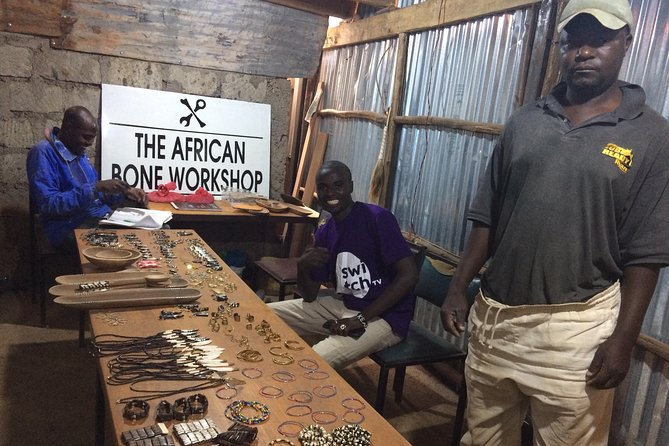
One planned stop is an African bone workshop. Here, you can see how discarded animal bone is turned into jewelry and other crafts. This is a small but important change in focus. The visit is not only about what Kibera lacks. It also shows skill, creativity, and ways people earn money from available materials.
The workshop gives you something concrete to discuss with the guide. You can ask about the making process, local sales, and the role of small businesses in community life. If you want to buy a craft item, ask clearly about the price and where the money goes. The supplied details do not promise that purchases are included or required, so treat shopping as optional.
Some outings have also included a community empowerment business making bags. That stop may depend on the day and the route, but it fits the broader purpose of the tour: showing local efforts, not just difficult conditions.
A few more options to weigh up in Nairobi
- Nairobi National Park Half-Day Tour; Free Wi-Fi connection
★ 5.0 · 878 reviews - Nairobi: National Park & Optional Elephants & Giraffe Center
★ 4.8 · 874 reviews - NAI NAMI: Nairobi Storytelling Tour with Street Children
★ 5.0 · 792 reviews - Nairobi National Park Half-Day Game Drive
★ 4.5 · 738 reviews
The school, orphanage, and education efforts

The school or orphanage is likely to be one of the most affecting stops. The tour can introduce you to children studying in a place created for orphans, along with the people working to provide education with limited funding.
You may hear about efforts to help talented children continue to boarding school. This offers a more complete picture than simply seeing poor facilities and moving on. Education becomes a source of hope, but also a reminder of how much depends on donations and small local initiatives.
This part requires sensitivity. Children should not be treated as props for holiday photos. Ask the guide about photography, keep your behavior calm, and let the school set the tone. A visit is most useful when it respects the people it hopes to support.
Families with older children have taken part, including children aged eight and nine. Parents should decide if their children are ready for difficult sights and a physically demanding walk. The tour can teach compassion and resilience, but it is not a light family attraction.
Kevin’s home and a family welcome

The personal home visit is the feature that makes this experience more than a standard neighborhood walk. You may visit Kevin’s house and meet family members, and some routes include his parents’ home as well.
That moment can change the way you see Kibera. A family home is not an abstract example of poverty. It is a place where people laugh, argue, welcome visitors, and carry on with ordinary routines. One account described the family as familiar in the most human sense, with the same mix of humor and disagreements found in families everywhere.
You should accept the invitation graciously but remember that you are entering someone’s private space. Keep questions respectful. Do not assume every family has the same experience, and do not press for details about income, housing, or personal hardship unless the guide opens that door.
The home visit also explains the trust behind the tour. Kevin and Ismael are not detached guides passing through for a few hours. Their family ties and community presence shape the entire experience.
The market, landfill, and railway track

The main street market shows Kibera as a place of trade and movement. You may see people buying daily goods, working, and managing the practical business of life. It can be crowded and noisy, so stay close to your guide and watch your footing.
The landfill area is harder to process. It brings the problems of waste, sanitation, and public services into clear view. Some people leave feeling frustrated that basic needs such as clean water, toilets, and showers remain difficult for many residents.
The railway track adds another layer to the route. It is a local landmark, but it also reinforces how little spare space exists in a dense settlement. Your guide can provide the context that a quick glance cannot.
These stops are not pleasant in the usual sightseeing sense. That is part of the point, but you should not confuse emotional discomfort with the whole story of Kibera. The settlement also contains families, schools, businesses, churches, friendships, and plans for a better future.
What the $65 price really covers
At $65 per person, this is not the cheapest way to spend a morning in Nairobi. The price includes a private guide and hotel pickup and drop-off, but not food or drinks.
The value comes from access and interpretation. You are paying for a guide with lived ties to Kibera, a private format, transport, and an introduction to places you would be unlikely to visit meaningfully on your own. The family visit and local school connection add depth that a generic city tour usually cannot provide.
The cost makes more sense for two or more people sharing a private outing. Solo visitors pay the full per-person rate, but the personal attention can be useful if you have many questions or want a slower conversation.
Do not book this expecting luxury, comfort, or a carefully polished attraction. Book it if you want time with a local guide and are prepared to see hard realities. The strongest value is educational and human, not visual.
Clothing, comfort, and safety
Wear close-toed shoes with good grip. Choose a pair you do not mind getting extremely dirty. If rain has fallen recently, the walk can become especially precarious.
Long walking routes over uneven surfaces call for practical clothing, though the tour information only specifically confirms the need for suitable shoes. Carry only what you need, keep personal items secure, and listen when the guide advises you where to walk.
Most people can take part, but the experience is not suitable for anyone who struggles with balance, agility, or uneven ground. An older visitor or anyone with walking difficulties should think twice before booking.
The reports of people feeling safe, including a solo woman, are encouraging. The guides’ local connections appear to help. Still, no tour can remove every risk from a crowded urban area, so use normal Nairobi precautions and remain with your guide.
How to get the most from the visit
Go with questions, but do not turn the tour into an interrogation. Ask about education, housing, employment, sanitation, and community projects in a way that invites explanation rather than demanding simple answers.
Bring patience. Pickup timing can shift, the walk may take longer than expected, and local life does not pause to make a perfect tour. The private format gives you a chance to slow down when a conversation matters.
I would also plan a quiet afternoon afterward. The experience may leave you thinking about public services, family responsibility, and the unequal starting points people face. It is possible to feel admiration, sadness, gratitude, and frustration in the same morning.
Free cancellation is available if you cancel at least 24 hours before the local start time. Changes or cancellations inside that window are not refunded, and poor weather can lead to a new date or a full refund.
Who should book Kevin’s Kibera Slum Tours?
I would recommend this tour to adults who want a serious, locally guided look at Nairobi beyond its usual attractions. It suits visitors who value conversation, community contact, and social context more than comfort.
It can work for families with children, but parents should prepare them for difficult conditions and make sure they can handle the walk. Solo women may find the private format and local guide reassuring, though everyone should make their own safety judgment.
I would skip it if you need smooth paths, fixed timing, air-conditioned sightseeing, or a light morning. I would also avoid booking during a tight connection day because the pickup can be delayed and the walking portion is demanding.
For the right person, this is one of Nairobi’s most meaningful experiences. You see hardship, but you also meet people working, studying, making things, raising families, and helping one another. That balance is what gives the tour its value.
FAQ
Where does Kevin’s Kibera Slum Tour take place?
The tour takes place in Kibera, Nairobi, Kenya.
How long does the tour last?
The experience lasts approximately four hours. About three hours are allocated to the Kibera visit itself.
What time does the tour start?
The stated start time is 8:00 am.
Is hotel pickup available?
Yes. Round-trip pickup and drop-off are offered from hotel accommodation anywhere in Nairobi.
Is the tour private?
Yes. Only your own group participates in the private activity.
What is included in the price?
The price includes a Kibera guide and hotel transportation in Nairobi.
Are food and drinks included?
No. Food and drinks are not included.
What places can I visit during the tour?
The route includes an African bone workshop, an orphanage school, Kevin’s house and family, a landfill, a train track, and the main street market.
Is the tour suitable for people with walking difficulties?
The walk can be treacherous, with uneven surfaces and difficult conditions after rain. Anyone with balance, agility, or walking issues should not book it.
What is the cancellation policy?
You can cancel for a full refund up to 24 hours before the experience starts. Cancellations or changes made less than 24 hours before the start time are not refunded. If poor weather causes the tour to be canceled, you will be offered another date or a full refund.
Just added in Nairobi
- Wildlife Capital: Half-Day Safari at Nairobi National Park★ 5.0 · 2 reviews
- 3 days maasai mara migration safari★ 4.5 · 7 reviews
- 4 Days Tour Landcruiser in Masai Mara and Lake Nakuru★ 5.0 · 10 reviews
- 4 Days Safari to Lake Nakuru N/P and Maasai Mara N/R★ 5.0 · 18 reviews
- Day Tour to Nairobi national park, Elephants, and Giraffe Center★ 3.5 · 8 reviews
- 6 Days Kenya Budget Group Safari★ 5.0 · 2 reviews
- Maasai Mara Day Trip★ 5.0 · 15 reviews
- 3 Days Masai Mara Wildebeest migration Budget safari★ 5.0 · 2 reviews
Kibera Community Tours, compared.




Kibera Slum Tour with Local Social Entrepreneurs
Read our review →



Browse the lists this tour appears in