

Reviewed · WALKING TOURS
Nairobi City Walk Tour
Nairobi reveals itself on foot. This 2-hour-40-minute walk links mosques, markets, parks, churches, government buildings, and the city’s railway story, giving you a useful first look at Kenya’s capital. I like the local guide approach, especially the chance to hear about daily life from people who know Nairobi well. I also like the mix of major landmarks and ordinary city spaces, including the market stalls and small urban parks.
The main consideration is the pace. You cover many stops and may walk for miles, while most visits last only 10 or 20 minutes. The rooftop view at the Kenyatta International Conference Center also costs extra, and a group can include up to 50 people. If you want a slow museum visit, this is not that tour. If you want to get your bearings quickly, it offers good value.
In This Review
- Key points about this Nairobi walking tour
- Starting near Wabera Street in central Nairobi
- Jamia Mosque and McMillan Memorial Library
- City Market and the first chance to shop
- University of Nairobi and the Maasai Market
- Uhuru Park and the Cathedral Basilica
- The KICC rooftop and Kenya’s Parliament
- Railway history, the National Archives, and Jeevanjee Gardens
- What $20 buys you
- John, Samson, and the human side of the walk
- Who should book this walk?
- Final decision: a useful first afternoon in Nairobi
- FAQ
- How long does the Nairobi City Walk Tour last?
- Where does the tour start?
- Where does the tour end?
- Is the KICC rooftop admission included?
- What languages are available?
- How far in advance can I cancel for a full refund?
Key points about this Nairobi walking tour

- Twelve central Nairobi stops: The route brings together religious buildings, markets, parks, civic sites, a university, a railway museum, and a national archive.
- Two souvenir markets: City Market and the Maasai Market offer traditional Kenyan items, with Maasai crafts receiving special attention.
- A local guide makes the difference: John is praised for clear explanations, easy conversation, and strong knowledge of Nairobi. Samson has also guided the walk.
- A useful first-day activity: The route helps you understand the city center before exploring further on your own.
- English and Spanish available: The tour includes a certified guide in either language, and John has been praised for his fluent Spanish.
- Low entry price, with one notable extra: At $20 per person, the walk includes fees and taxes, but the KICC rooftop admission is not included.
Starting near Wabera Street in central Nairobi
The tour starts at Carrefour St. Ellis, on Wabera Street, Nairobi. It ends back at the same meeting point, which is useful if you are planning another activity afterward or want a familiar place to finish.
The meeting point is near public transportation, and confirmation arrives when you book. No private transportation is included, so you should expect the route to be entirely on foot unless you arrange your own transport to and from the start.
The route is packed with stops. Some are short introductions rather than full visits, with 10 minutes at several locations and 15 or 20 minutes at others. I would treat the tour as a guided orientation, not a series of full museum tours. The value comes from the connections between places and the explanations along the way.
Wear comfortable shoes and plan for a proper walk. One group described walking for miles, so the published duration may feel more demanding than a casual stroll. Since the group can reach 50 people, ask where to stand if you want to hear every explanation clearly.
More Walking Tours in Nairobi
- Nairobi: Historic and Modern Highlights Walking Tour
★ 4.8 · 703 reviews - Nairobi Historical Walking City Tour
★ 5.0 · 258 reviews - Nairobi Downtown Walking Tour
★ 4.7 · 208 reviews
Jamia Mosque and McMillan Memorial Library
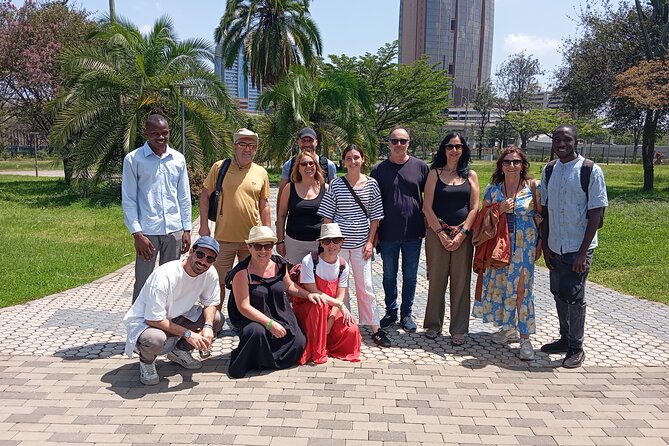
Jamia Mosque is the first listed stop. It is described as the biggest mosque in Kenya, and the 10-minute visit gives the route an early look at Nairobi’s religious and cultural life. Admission is free.
You should think of this stop as an exterior or brief orientation unless the guide gives you more time. The schedule does not allow for a long architectural visit. Still, beginning with such an important place gives the tour a useful sense of the city’s religious diversity.
Next comes McMillan Memorial Library, an old city-center library built in 1929 by William Macmillan’s wife in his memory. The 10-minute stop is brief, but the building adds an older layer to a route otherwise filled with active streets and modern city life.
I like the contrast here. You move from a major place of worship to a civic and literary building, then continue toward the markets. Nairobi’s story is easier to grasp when you see these different institutions close together rather than visiting only one type of attraction.
City Market and the first chance to shop
City Market is scheduled for 20 minutes and sells traditional items made by different Kenyan communities, with Maasai goods receiving particular attention. It is one of the better places on the route to consider a souvenir.
The short time limit is helpful if you want a quick look and do not want shopping to take over the day. It is less helpful if you enjoy comparing crafts, asking questions, or bargaining at length. I would decide before arriving if you want to buy something, since a focused choice is easier than trying to inspect everything in a busy market setting.
The tour’s shopping stops are also useful for cultural context. You are not simply passing a shop selling generic gifts. You are being introduced to traditional items connected with communities in Kenya. The guide can help explain what you are seeing, although the precise amount of shopping time depends on how the walk runs that day.
University of Nairobi and the Maasai Market
The University of Nairobi receives 20 minutes. It is described as the oldest and biggest university in Eastern Africa, making it an important stop for understanding education and public life in the region.
You should not expect a campus tour in the formal sense. The itinerary gives enough time for an introduction and explanation, not an extended visit to university buildings. Its value is as a city landmark and a chance to see how Nairobi’s central district includes educational institutions alongside government offices and commercial areas.
The Maasai Market follows, also with 20 minutes. This is another major souvenir stop, selling Maasai items as well as products from other Kenyan communities. If you want to buy traditional crafts, this is likely the most important part of the walk.
The two markets may sound similar, but they help make shopping a planned part of the tour rather than an accidental stop. You can compare the selection and prices, then decide what you actually want. I would bring a little patience and keep the time limit in mind. A short market visit can pass quickly.
A completely different kind of day:
- Nairobi National Park Half-Day Tour; Free Wi-Fi connection
★ 5.0 · 878 reviews - Nairobi: National Park & Optional Elephants & Giraffe Center
★ 4.8 · 874 reviews - NAI NAMI: Nairobi Storytelling Tour with Street Children
★ 5.0 · 792 reviews - Nairobi National Park Half-Day Game Drive
★ 4.5 · 738 reviews
Uhuru Park and the Cathedral Basilica
Uhuru Park is a 15-minute stop in the middle of Nairobi. Its green setting changes the mood after the markets and city streets. Nairobi is known here as a green capital, and this park shows that open public space can exist within the central district.
Fifteen minutes is enough for a look and a guide’s explanation, but not for a leisurely park visit. If you want to sit, wander, or take your time with photographs, you may need to return later on your own. That is one advantage of ending the tour at the starting point: you can note places worth revisiting.
The Cathedral Basilica of the Holy Family comes next, with 10 minutes scheduled. This Catholic church adds another religious site to the route and gives you a quick sense of the city center’s mixture of faiths and institutions.
Again, this is a short stop. I would not book the walk expecting lengthy interior visits at every religious building. The strength is variety. In a single morning or afternoon, you see a mosque, a Catholic cathedral, public parks, markets, and government buildings.
The KICC rooftop and Kenya’s Parliament
The Kenyatta International Conference Center is one of the route’s highlights. The guide takes you to the rooftop for a clear view of Nairobi, with 15 minutes planned for the stop.
This is the one place where an admission fee is not included. The tour includes all other listed fees and taxes, but you should budget separately for the KICC rooftop ticket. The extra cost may be worthwhile if you want a broad view of the city and a better sense of how the central district fits together.
The rooftop also helps tie the walking route together. After seeing individual streets and buildings from ground level, you can look across the city and understand its scale. Keep in mind that weather and visibility can affect the view, and the stop remains fairly short.
The Parliament of Kenya follows, with 10 minutes. The description calls it a tower where members of Parliament hold meetings. The stop offers a quick introduction to Kenya’s national government and the role of the capital as a political center.
You should not expect to enter or tour the parliamentary complex. The scheduled time and description point to an outside explanation or brief viewing. Security and access rules can also matter around government buildings, so follow your guide’s instructions and avoid wandering away from the group.
Railway history, the National Archives, and Jeevanjee Gardens

The Nairobi Railway Museum is listed for 10 minutes. The railway was built by the British with help from Indian workers, and its development led to the creation of Nairobi. That fact gives the city a direct link to colonial transport, migration, labor, and urban growth.
Ten minutes is not enough for a full museum visit. I would regard this as a short historical stop, useful for understanding why Nairobi developed where it did. If the railway story interests you, note the museum’s location and consider returning with more time.
The National Archives on Moi Avenue is another 10-minute stop. It holds artifacts and documents related to the Kenyan government’s history since independence. This adds material and political context after the railway discussion.
The schedule again favors an introduction rather than a careful look through the collection. You may find that the guide’s explanation is the main benefit of the stop. The route shows you where to return if you want a longer visit, but the walking tour itself keeps moving.
The final stop is Jeevanjee Gardens, a small park in Nairobi. It offers a quieter ending after the archives and central streets. The park is not presented as a major attraction, and the 10-minute visit is modest, but small public spaces often help you see how city life works between the famous buildings.
You then walk back to the original meeting point. By this stage, you have crossed a broad slice of central Nairobi and seen the city through several lenses: faith, education, trade, politics, public space, records, and transport.
What $20 buys you

At $20 per person, this is a strong-value introduction to central Nairobi. The price includes all listed fees and taxes, plus a certified English or Spanish guide. Most of the stops do not charge admission, so you are mainly paying for the guide’s time, route planning, explanations, and navigation.
The value rises if you are in Nairobi for a short visit or have one free afternoon. You can cover 12 places without arranging separate taxis or researching a route. A guide also adds local detail that you would miss by simply walking between buildings.
The value is less clear if you want extensive time inside museums, markets, or religious sites. The stop lengths are tight, and the KICC rooftop costs extra. Private transportation is not included, so you must get yourself to Wabera Street and back from the end point.
The tour is generally bookable about 15 days ahead on average. That does not guarantee availability for your dates, but it suggests that planning ahead is sensible, especially if you need Spanish-language guiding or have a fixed schedule.
John, Samson, and the human side of the walk
John is the named experience provider and the guide most closely associated with the tour. He is described as young, energetic, friendly, and clear when explaining Nairobi’s history. Those qualities matter on a long urban walk, where a dry lecture or hard-to-hear voice can quickly wear you down.
John has also been praised for answering questions and navigating the city confidently. That is especially useful on a route with many short stops. You want a guide who can keep the group moving without rushing every explanation.
Samson has also been named as a guide on the experience. The tour includes English and Spanish support, and John has been praised for speaking Spanish very well. If language is important to you, confirm the available guide and language when booking.
The strongest praise centers on the personal side of the experience. John explains not only the sights, but also life in Nairobi and Kenya. That makes the walk more than a checklist of buildings. You get a local introduction to how the city fits together.
Who should book this walk?
I would choose this tour if you want a first look at Nairobi before visiting other parts of Kenya. It suits first-time visitors, people with a spare day, and anyone who prefers learning a city by walking through its center.
It also works well for people who want a guide but do not want to pay for a private vehicle. The public route keeps the price low and places you close to markets, parks, churches, civic buildings, and historical sites.
You may want a different plan if you have limited mobility, dislike long walks, or prefer slow visits. The available information says most people can participate, but the route is still substantial and includes many stops. A group of up to 50 can also feel less personal than a small walking tour.
I would be cautious about booking it as your only cultural activity in Nairobi. This tour gives you a city-center foundation, not a full tour of Kenya’s capital. It does not replace a longer visit to the railway museum, National Archives, or a market if those subjects interest you.
Free cancellation is available up to 24 hours before the start time for a full refund. Cancellations within 24 hours are not refunded, and changes during that period are not accepted.
Final decision: a useful first afternoon in Nairobi
I would book the Nairobi City Walk Tour if I wanted an affordable, guide-led introduction to the capital. The best parts are the variety of stops, the two traditional markets, the KICC rooftop option, and the chance to ask a local guide direct questions.
John’s clear explanations and friendly manner are a major part of the appeal, with Samson also named as a guide. The tour earns its $20 through orientation and local insight rather than long admissions or luxury transport.
Go in with sensible expectations: wear good shoes, allow nearly three hours, budget for the KICC rooftop, and expect brief visits at many stops. For a first day in Nairobi, that is a useful trade. You see a lot, learn how the center is organized, and finish with a better idea of where you want to return.
FAQ
How long does the Nairobi City Walk Tour last?
The tour lasts approximately 2 hours and 40 minutes.
Where does the tour start?
It starts at Carrefour St. Ellis, PR7F+G34, Wabera Street, Nairobi.
Where does the tour end?
The activity ends back at the original meeting point.
Is the KICC rooftop admission included?
No. Admission to the Kenyatta International Conference Center rooftop is not included. The other listed tour fees and taxes are included.
What languages are available?
The tour includes a certified guide in English and Spanish. John has been praised for speaking Spanish very well.
How far in advance can I cancel for a full refund?
You must cancel at least 24 hours before the experience start time to receive a full refund. Cancellations within 24 hours are not refunded.
Just added in Nairobi
- Wildlife Capital: Half-Day Safari at Nairobi National Park★ 5.0 · 2 reviews
- 3 days maasai mara migration safari★ 4.5 · 7 reviews
- 4 Days Tour Landcruiser in Masai Mara and Lake Nakuru★ 5.0 · 10 reviews
- 4 Days Safari to Lake Nakuru N/P and Maasai Mara N/R★ 5.0 · 18 reviews
- 6 Days Kenya Budget Group Safari★ 5.0 · 2 reviews
- Maasai Mara Day Trip★ 5.0 · 15 reviews
- Day Tour to Nairobi national park, Elephants, and Giraffe Center★ 3.5 · 8 reviews
- 3 Days Masai Mara Wildebeest migration Budget safari★ 5.0 · 2 reviews
Walking Tours, compared.

Walking Tour Through Old Town Mombasa and Fort Jesus
Read our review →

Nairobi Walking tour:Explore History Culture and Traditions
Read our review →

Nairobi City Walking Tour with Traditional Kenyan Lunch
Read our review →

Browse the lists this tour appears in