

Reviewed · CITY TOURS
Nairobi City
Nairobi’s story is written in its streets. This $20 city tour links colonial buildings, independence landmarks, public parks, markets, and government offices into a useful introduction to Kenya’s capital. I like the strong historical focus, and I also like that certified guide John brings a calm, helpful style to the walk. The main consideration is that private transport is not included, so you should be ready to walk between stops.
I especially like the mix of major sights and smaller public places, from the Dedan Kimathi statue to Jeevanjee Gardens. John’s ability to answer questions and suggest more places to see, eat, and explore adds real value. Still, this is a brisk three-hour overview, not a slow museum visit, and a group can include as many as 50 people.
In This Review
- Key points at a glance
- Why this Nairobi tour works as an introduction
- Kipande House and the marks of colonial rule
- The Maasai Market brings the city’s trade to life
- Nairobi Archives and the political story of Kenya
- Fairmont The Norfolk and Nairobi’s colonial connections
- Dedan Kimathi and the road to independence
- Uhuru Park offers 30 minutes of breathing room
- Jeevanjee Gardens and a more local public space
- Nairobi Governor’s Office and the modern county system
- Railways Train Station recalls Nairobi’s first expansion
- Tom Mboya’s statue and the cost of political change
- Three hours, a large group, and practical planning
- Who should book this $20 Nairobi city walk?
- Should you book it?
- FAQ
- How long does the Nairobi city tour last?
- How much does the tour cost?
- What is included in the tour?
- Is private transportation included?
- Where does the tour start and end?
- Can I cancel for a full refund?
Key points at a glance
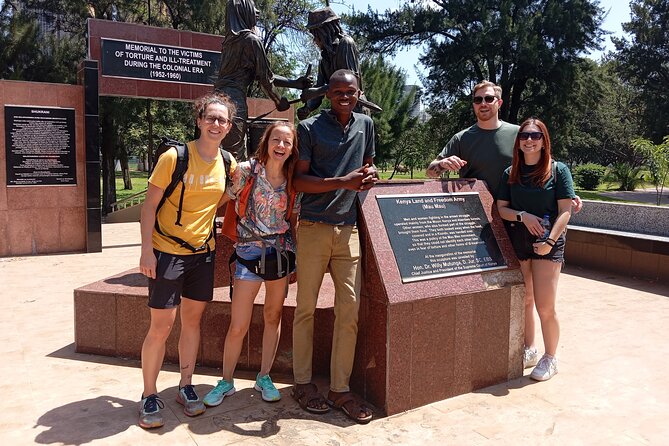
- Kipande House tells an early colonial story: See one of Nairobi’s first tall buildings, built in 1913 for the identification of Kenyan people.
- The Maasai Market adds a shopping stop: Browse wooden crafts, magnets, Kenyan clothing, bracelets, and other items.
- Kenya’s independence story comes alive: The Dedan Kimathi and Tom Mboya statues connect the city center to the struggle for self-rule.
- Uhuru Park offers a change of pace: Spend time in a central public park opened by Kenya’s first president in 1969.
- The route covers both famous and overlooked places: You see the Norfolk hotel, Nairobi Archives, Railways station, government offices, and small gardens.
- The price is easy to justify: At $20 per person, you get about three hours with a certified guide and no admission fees listed for the stops.
Why this Nairobi tour works as an introduction

Nairobi can feel hard to read at first. Its modern office blocks, colonial-era buildings, memorials, parks, markets, and government institutions sit close together, but their connections are not always obvious when you walk alone.
This tour gives you a framework. You move through the city center while learning how Nairobi developed from a British colonial settlement into the capital of an independent Kenya. The route also brings in the current political structure of the country, including Nairobi’s position as the smallest of Kenya’s 47 counties and home to its largest city.
I like that the experience does not limit itself to one type of attraction. You are not spending three hours looking only at statues or only at old buildings. Instead, the route moves between architecture, public space, trade, politics, national memory, and daily city life.
The certified guide is an important part of the value. John was praised for being calm, professional, and engaging, while also answering questions and offering suggestions for other things to see, eat, and do. That matters on a city walk. A guide who listens can help turn a standard introduction into a more useful first afternoon in Nairobi.
The tour costs $20 per person. Since the listed stops have no admission charge, most of that price pays for the guide and the organization of the route. For a visitor with only a short time in Nairobi, that is a reasonable deal. If you already know the city well, or prefer to explore at your own pace, the value is less clear.
A few more options to weigh up in Nairobi
- Nairobi National Park Half-Day Tour; Free Wi-Fi connection
★ 5.0 · 878 reviews - Nairobi: National Park & Optional Elephants & Giraffe Center
★ 4.8 · 874 reviews - NAI NAMI: Nairobi Storytelling Tour with Street Children
★ 5.0 · 792 reviews
Kipande House and the marks of colonial rule
The first stop is Kipande House, one of Nairobi’s earliest tall buildings. It was built in 1913 by the British for the identification of Kenyan people.
That detail gives the building more weight than its age alone. Kipande refers to an identification system used during the colonial period, so this is a place where architecture and administration meet. You are looking at an early high-rise, but you are also being introduced to the way colonial rule documented and controlled local people.
The visit lasts about 15 minutes. That is enough for an explanation and a look at the building, but not enough for a long architectural study. I would pay close attention to the guide here, since the historical meaning is more important than the length of the stop.
This is also a good early reminder that Nairobi’s past is not simply a story of railway building and grand hotels. The city’s growth was tied to systems that affected Kenyan identity, movement, and access to power.
The Maasai Market brings the city’s trade to life
The Maasai Market provides a change in mood. Here you can see wooden crafts, magnets, Kenyan clothes, bracelets, and other goods offered for sale.
You get about 25 minutes, so think of this as a short browse rather than a long shopping session. The market gives you a chance to look at items connected with Kenyan culture and design, and it may be the easiest place on the route to pick up a small souvenir.
I like having a market on a history walk because it keeps the experience from becoming too formal. Nairobi is not only a collection of memorials and official buildings. It is also a place where people sell, bargain, make, display, and carry on with ordinary business.
The practical challenge is time. If you enjoy shopping, 25 minutes can disappear quickly. You may need to choose between looking carefully and buying something. Keep your attention on the guide’s meeting instructions so you do not hold up the group.
Nairobi Archives and the political story of Kenya

The stop at the archives introduces a collection of artifacts from African nations along with material on Kenya’s political history.
The information supplied for this stop does not give it a numbered position or a precise time, so the schedule may be flexible. It is best to see it as an important part of the route, even though the timing is not as clearly defined as the other stops.
This is likely to be one of the most useful sections for anyone who wants more than photographs. Artifacts can place Kenya in a wider African setting, while political material helps explain the national events referred to later at the Kimathi and Mboya statues.
I would not expect a full museum visit within a three-hour city walk. The value here is in getting a guided introduction and learning what deserves a longer return visit. If political history is your main interest, ask John questions while you are here.
More city tours in Nairobi:
- Nairobi Historical Walking City Tour
★ 5.0 · 258 reviews - Nairobi City Walking Tour with Traditional Kenyan Lunch
★ 5.0 · 106 reviews - Nairobi Cultural and Historical City Tour with a Local
★ 5.0 · 67 reviews - Nairobi: City Site-Seeing Bus Tour
★ 4.5 · 35 reviews
Fairmont The Norfolk and Nairobi’s colonial connections
Fairmont The Norfolk is a historic hotel included on the route. The tour presents it as the place connected with Queen Elizabeth’s crowning.
You spend about 25 minutes at this stop. The hotel gives the tour another view of Nairobi’s colonial past, this time through a grand lodging place associated with British power and important visitors.
The contrast with Kipande House is useful. Kipande House points to colonial identification and administration, while the Norfolk represents the formal world of officials, dignitaries, and elite hospitality. Seeing both helps you understand that Nairobi’s early development had very different meanings for different groups.
This is an exterior-focused sightseeing stop based on the information provided. No hotel admission is included, and no private transport is provided. Treat it as a place to see and hear about, not as a hotel tour.
Dedan Kimathi and the road to independence

The Dedan Kimathi statue honors a Kenyan leader who led the Mau Mau movement before independence. The statue was placed in the city center to recognize his work.
You have about 15 minutes here. That may sound short, but a memorial stop does not require a long stay if the guide gives clear context. The important thing is the link between a person, a movement, and the public memory of Kenya’s path to independence.
This is one of the strongest historical moments on the route. The statue is not just a photo stop. It offers a chance to ask about the Mau Mau movement, the struggle against British rule, and how Kenya remembers its independence leaders.
The subject can be politically and historically complex. A short city tour cannot cover every side of it, so use your time well. Ask John for the basic timeline and for suggestions on where to learn more if this part of Kenyan history catches your attention.
Uhuru Park offers 30 minutes of breathing room

Uhuru Park is the longest stop, with about 30 minutes set aside. The park is in the city center and was opened to the public on May 23, 1969, by Kenya’s first president.
After several buildings and monuments, the park gives you room to pause. You can look at Nairobi as a public city rather than only as a place of official history. Its location also shows how open space and civic life fit into the capital’s center.
I like the pacing here. A walking tour needs a break, especially when the itinerary includes ten stops. The park can be a useful place to listen, ask questions, and let the earlier information settle before moving on.
The tour does not list private transportation, so your physical effort matters. The stated requirement is a moderate level of fitness. You do not need to treat this as a strenuous trek, but comfortable shoes and an ability to keep moving through the city will make the experience easier.
Jeevanjee Gardens and a more local public space
Jeevanjee Gardens is a smaller park on the way toward the west side of the city. Local people use it to relax during the day, and it was donated to the public by an Asian-born entrepreneur in Kenya.
The stop lasts about 15 minutes. It is brief, but it adds a useful social detail to the tour. You are seeing a public place shaped not only by government planning, but also by private generosity and the daily habits of people who live in the city.
This is the kind of stop I appreciate on an introductory walk. Famous sights explain national events, while a small garden helps you notice how people use Nairobi between those larger moments.
Do not expect a large park or a long nature visit. The point is the setting, the story of the donation, and the chance to see another corner of the central city.
Nairobi Governor’s Office and the modern county system
The route then passes the Nairobi Governor’s Office. The explanation connects the building with Kenya’s administrative structure: the former eight provinces were divided into 47 counties, with Nairobi being the smallest county and containing the country’s largest city.
This stop lasts about 15 minutes. It is a useful link between historical Nairobi and the city you see today. The tour is not only concerned with independence-era figures and colonial buildings. It also explains how the capital is governed now.
For visitors who find political geography confusing, this is a helpful moment to ask questions. Nairobi is both a county and Kenya’s major urban center, so its local government has an important role in everyday city life.
The office itself may not be a dramatic sight. Its value comes from the explanation, not from expecting an attraction with extensive public displays.
Railways Train Station recalls Nairobi’s first expansion
The Railways Train Station was built by the British when they first arrived in Kenya. The stop lasts around 20 minutes.
Railway history is central to Nairobi’s early growth, and this stop gives the city’s development a physical anchor. You can connect the station with the arrival of British power, the growth of the settlement, and the transport routes that helped shape the capital.
This stop pairs well with Kipande House. One explains a system of identification, while the other points to the transport infrastructure that helped build the city. Together, they make Nairobi’s early colonial period easier to understand.
Again, the tour does not include private transportation or a separate rail experience. You are visiting the station as a historic city landmark with a guide, not taking a train as part of the activity.
Tom Mboya’s statue and the cost of political change
The Tom Mboya statue honors a statesman considered one of Kenya’s fathers of the nation. Mboya was killed in July 1969 in the central business district, and the statue was later raised in his memory.
The stop is short, about 10 minutes. It is still significant because it shows how Nairobi’s streets preserve the memory of political violence and national leadership.
Placed alongside the Dedan Kimathi statue, this stop creates a broader story. Kimathi represents the independence struggle before self-rule, while Mboya represents the political generation that helped shape the new nation. The two memorials invite you to think about how Kenya’s independence story continued to develop after colonial rule ended.
A guide makes a real difference here. The statue itself cannot explain the political setting, so John’s calm and professional approach is useful. If you want to understand the sequence of events, ask him to connect this stop with the archives and Uhuru Park.
Three hours, a large group, and practical planning
The experience lasts approximately three hours and includes about ten stops. The listed stop times add up to more than three hours, so the schedule likely depends on short movements, quick explanations, and some flexibility in how long the group remains at each place.
The maximum group size is 50 people. That is the biggest practical limitation. A large group can make it harder to hear every word, ask private questions, or move at the same pace as a small walking party.
John’s reported strengths help here. He is described as calm, professional, engaging, and willing to answer questions. Still, if you prefer a quiet, slow tour with plenty of personal attention, a group of up to 50 may feel too broad.
The experience uses a mobile ticket, and confirmation is received when you book. It is near public transportation, which helps with reaching the city center. The stated meeting point is Carrefour St. Ellis, PR7F+G34, on Wabera Street, Nairobi. The closing instructions also refer to the Hilton location and an UPS drop-off point, so I would confirm the exact starting and ending spot before you set out.
The tour ends back at the meeting point. Since private transport is not included, plan around walking and city movement rather than expecting a vehicle between landmarks.
Free cancellation is available if you cancel at least 24 hours before the start time. Changes made less than 24 hours ahead are not accepted, and poor weather can lead to a new date or a full refund.
Who should book this $20 Nairobi city walk?
I would choose this tour if you are visiting Nairobi for the first time, have only a few hours, or want a guided introduction before exploring more on your own. It suits people who enjoy public history, city architecture, political landmarks, and short stops rather than long museum visits.
It is also a good fit if you want practical suggestions after the walk. John has been praised for recommending additional sights, food, and activities, which can help you plan the rest of your stay.
I would think twice if you dislike group walks, need private transport, or want in-depth time at each location. The tour covers a lot of ground, and the group limit of 50 may reduce the personal feel.
Should you book it?
Book this Nairobi city tour if you want a low-cost historical orientation with a certified guide and a broad range of sights. For $20, you receive about three hours of explanation, city walking, and access to a useful first look at Nairobi’s colonial past, independence movement, public parks, political memorials, and present-day administration.
The best reason to book is the combination of places. Kipande House, the Norfolk, the Railways station, the archives, Kimathi’s statue, Mboya’s statue, and Uhuru Park each show a different piece of the capital’s story.
Choose another format if you want a private guide or a slower schedule. For a first introduction, though, this is a sensible way to get your bearings and leave with better questions for the rest of your time in Nairobi.
FAQ
How long does the Nairobi city tour last?
The tour lasts approximately three hours.
How much does the tour cost?
The price is $20 per person.
What is included in the tour?
A certified guide is included. Admission tickets are listed as free for the stops.
Is private transportation included?
No. Private transportation is not included, so you should be prepared to walk between locations.
Where does the tour start and end?
The stated meeting point is Carrefour St. Ellis, PR7F+G34, Wabera Street, Nairobi. The activity ends back at the meeting point, although the closing directions also refer to the Hilton location and an UPS drop-off point. Confirm the exact location before departure.
Can I cancel for a full refund?
Yes, if you cancel at least 24 hours before the experience start time. Cancellations made less than 24 hours in advance are not refunded, and poor weather may lead to a different date or a full refund.
Just added in Nairobi
- Wildlife Capital: Half-Day Safari at Nairobi National Park★ 5.0 · 2 reviews
- 3 days maasai mara migration safari★ 4.5 · 7 reviews
- 4 Days Tour Landcruiser in Masai Mara and Lake Nakuru★ 5.0 · 10 reviews
- 4 Days Safari to Lake Nakuru N/P and Maasai Mara N/R★ 5.0 · 18 reviews
- Day Tour to Nairobi national park, Elephants, and Giraffe Center★ 3.5 · 8 reviews
- 6 Days Kenya Budget Group Safari★ 5.0 · 2 reviews
- Maasai Mara Day Trip★ 5.0 · 15 reviews
- 3 Days Masai Mara Wildebeest migration Budget safari★ 5.0 · 2 reviews
City Tours, compared.

Tusks, Fort Jesus, Old Town, Beach and City Tour
Read our review →
Nairobi City Walking Tour with Traditional Kenyan Lunch
Read our review →
Nairobi Cultural and Historical City Tour with a Local
Read our review →

Private City Tour with Fort Jesus & Haller Park
Read our review →Browse the lists this tour appears in